
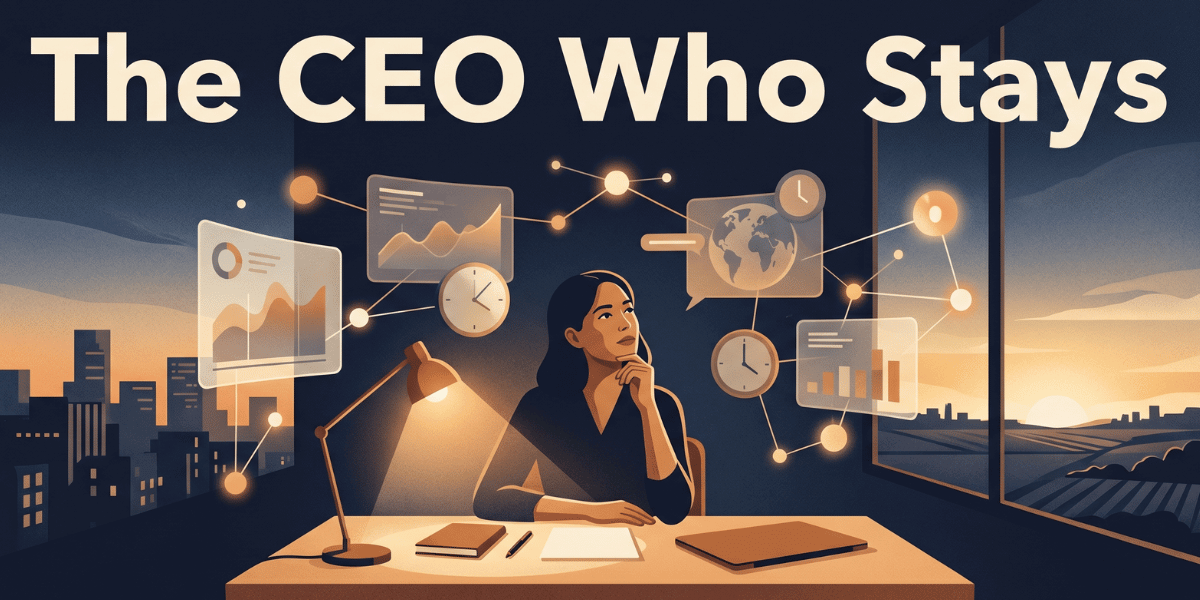
In November 2025, our founder Opher Brayer spoke at a Microsoft event in Toronto, sharing a prediction that made a few leaders in the room uncomfortable.
On stage, he put it plainly: Starting January 2026, CEOs are going home.
Not fired. Not retired. Going home. With their bonuses and their golden parachutes and their very expensive umbrellas, before the rain really starts.
Nobody laughed. Nobody disagreed either.
Fifty-five CEOs in three months
Fast forward to Q1 2026. Russell Reynolds Associates just released their Global CEO Turnover Index. Fifty-five CEOs have already exited across 13 major stock exchanges. In three months. And those are just the listed companies. Spotify. Walmart. Lululemon. Target. Indigo. Disney. Adobe. Two days ago, Apple.
So. About that prediction.
It wasn't incompetence
Here’s what we think actually happened, because it wasn’t incompetence. These were excellent CEOs. Many of them extraordinary. They built things. They led through COVID. They managed complexity that would flatten most people.
But the game changed speed. And speed is not just faster. Speed is a different cognitive operating system.
When the pace of decision-making doubles, then doubles again, the old model breaks. The old model was: have a meeting, schedule another meeting, bring in a consultant, form a committee, revisit in Q3. That model worked for a world where the window between insight and action was measured in quarters.
That window is now measured in hours.
And here’s the part that matters. Most of these CEOs understood AI intellectually. They read the right books. They attended Davos. They hired a Chief Digital Transformation Officer, which is a title that sounds important and, in most organizations, means absolutely nothing.
They delegated mastery. And you cannot delegate mastery.
What 5AM looks like
We have a benchmark for this. A CEO we’ve never met, from a company you know.
Tobi Lütke at Shopify.
The story, as it’s been reported: three years ago, instead of watching Netflix, he started spending hours at 5AM and 11PM teaching himself AI. Not reading summaries. Not getting briefings. Building agents. Understanding workflows. Learning how the thing actually thinks. He wanted to be the best person in his company at AI before he asked a single employee to adopt it.
That’s not a management philosophy. That’s a different category of leader.
Because here’s the thing about CEOs. You don’t become a CEO without being excellent at something. Usually several things. Finance. Sales. Operations. Product. The best ones know enough about every VP’s domain to ask the question that nobody else will ask.
Now AI touches every one of those domains simultaneously. It changes decision speed. Development speed. Learning speed. Innovation speed. The CEO who doesn’t understand how an agent thinks, how a workflow breaks, how a copilot can compress a three-month process into one focused hour — that CEO is navigating by a map that no longer matches the territory.
Tobi didn’t hire someone to hold the map. He learned to read it himself.
Same letters. Different job.
He didn’t stay a Chief Executive Officer. He became a Chief Executive Orchestrator, same letters C.E.O different meaning. Someone who knows how to manage 2,000 people and 20,000 AI agents, because he understands both.
That’s a different job. And it requires a different kind of expertise.
I don't want to be on that list
Now the part we didn’t fully predict in November, but we’re seeing clearly in April.
Some CEOs are coming to us and saying: I don’t want to be on that list.
Not in the abstract. Specifically. Personally. They’re sitting down and saying, teach me. Coach me. I want to be the best in AI in my company, and I want to build the organization that can move at this speed. I don’t want to leave with my umbrella before the storm.
That is, honestly, one of the more hopeful things I’ve seen this year.
Because what we do at Impro.ai isn’t just coaching employees. We work across the entire organization, which means we know every person in it — their performance patterns, their coachability, their behavioral signatures under pressure. The CEO gets something almost no one else can offer: a real-time picture of whether their organization is actually capable of the transformation they’re asking for, and what it will take to get there.
The bottleneck is almost never the employees. It’s almost always that the leaders stopped learning before the employees did.
You can't lead what you don't understand
The executives who went home weren’t weak. They were operating at the speed they were trained for, in a world that changed the speed limit without sending a memo.
The ones who will stay are not necessarily the most technically sophisticated. They’re the ones who decided that AI mastery is not optional, not delegatable, not something you outsource to a vendor or a new VP hire.
It is the next domain. Like finance. Like sales. Like understanding your customers.
You can’t lead what you don’t understand. You can’t orchestrate what you’ve never practiced.
And if you’re a CEO reading this and wondering whether you’re behind, the answer is probably yes. But you already knew that. The question is what you’re doing at 5AM.
Impro.ai works with enterprise organizations to accelerate human performance alongside AI adoption. If you’re a CEO who wants to lead from the front of this change, we’d like to talk.