
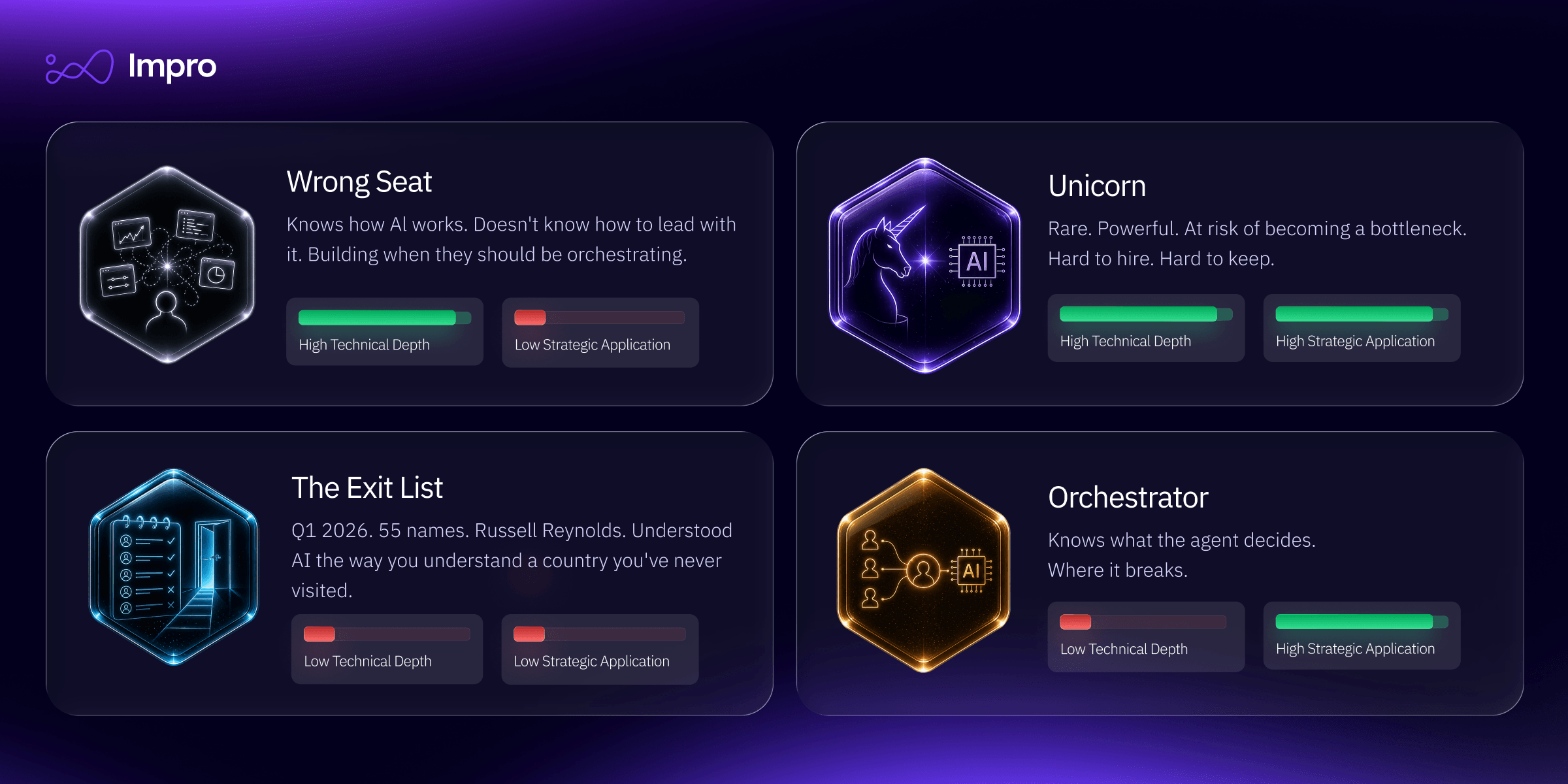
AI strategic fluency is what every board says they want from their leaders. And almost none of them have actually built it. The conversation usually goes like this: someone schedules a workshop, someone hires a consultant, and everyone goes back to doing exactly what they were doing before.
This pattern has repeated itself for five years. And the confusion is costing companies something they can’t recover: time at the front of a very fast race.
Here’s the confusion in plain language: organizations are equating AI mastery with technical depth. They’ve concluded that understanding AI means knowing how to build it. And since most executives have no interest in becoming software engineers at 54, they conclude — reasonably but wrongly — that AI fluency belongs to someone else.
It doesn’t.
Table of contents
The matrix most leaders are misreading
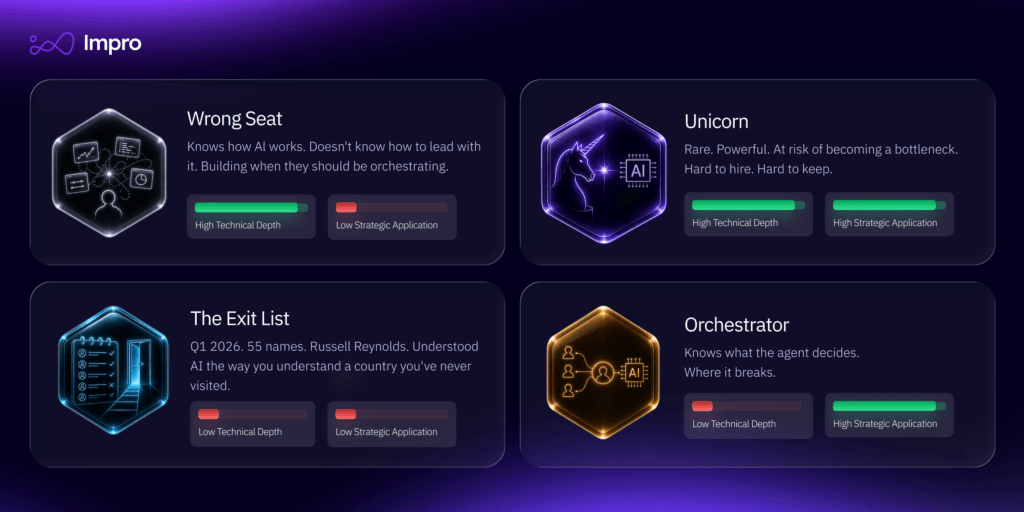
We use a 2×2 framework when working with executive teams. One axis is Technical Depth: how much a leader knows about how AI actually works at a code or architecture level. The other is Strategic Application: how well a leader can use AI to make better decisions, design better workflows, and move faster.
The mistake most leaders make is assuming these two axes are the same thing. That you need high technical depth to have high strategic application. They are not the same thing. At all.
The top-right quadrant: high technical depth, high strategic application. This leader is rare — and, honestly, probably a bottleneck. They spend half their time in implementation when they should be in orchestration.
The bottom-right quadrant: low technical depth, high strategic application. This is Tobi Lütke. He didn’t learn Python. He didn’t train models or debug APIs. But he can tell you exactly what an agent decides, where it breaks, how to design a workflow that uses it well, and when to override it with human judgment. He can ask the question nobody else in the room will ask — because he practiced enough to know what the right question is.
That’s the target. Low-to-moderate technical depth. High AI strategic fluency.
The uncomfortable truth
Most leaders reading this are in the bottom-left quadrant. Low technical depth and low AI strategic fluency. They understand AI the way you understand a country you’ve never visited. You’ve read about it. You could describe the food at a dinner party. But you’ve never navigated its streets at night when your phone dies.
Russell Reynolds’ Global CEO Turnover Index recorded 234 CEO departures globally in 2025 — a second consecutive record year, up 16% from 2024 and 21% above the eight-year average. The trend is continuing into 2026. Not because these were poor leaders. Because they had a map that no longer matched the territory, and they never updated the map.
What AI strategic fluency actually looks like in practice
It means you can describe, in plain language, what one AI agent in your organization does — and where it fails. It means you’ve used a copilot to pressure-test a decision you were about to make.
It means when someone says “we’re deploying an AI workflow for customer intake,” you don’t nod politely. You ask:
- What does the agent do when it hits an edge case?
- Who has override authority?
- What’s the feedback loop that makes it smarter over time?
None of those questions require code. All of them require practice.
That’s AI strategic fluency. It’s a skill, not a credential.
The gap most organizations are missing
Leaders have been told to get their organizations AI-literate. So they’ve run workshops, purchased platforms, hired digital transformation leads, and watched their teams go through the motions. Meanwhile, the leaders themselves — the people setting direction, approving investments, modeling behavior — have operated on the assumption that their job is to point at AI, not to practice it.
You cannot lead what you’ve never practiced. Not in surgery. Not in sales. Not here.
The leader who claims “our organization is AI-ready” while personally unable to design a simple workflow, prompt a model to challenge their own assumptions, or explain agent logic to a board — that leader isn’t leading transformation. They’re presiding over theater.
And their team knows it.
This is precisely where hybrid intelligence comes in: building the human capability alongside the technology, so organizations don’t just deploy AI — they can actually lead it.
What’s shifting
The executives coming to Impro.AI now aren’t sending their HR directors. They’re coming themselves. Sitting down. Saying: I don’t want to learn AI. I want to practice it. Teach me to use it the way I use finance: as a lens for decision-making, not a department I delegate to.
That’s the right question. Finally.
The goal isn’t to become the most technically sophisticated person in the room. It’s to become the most strategically fluent one. The one who knows what the technology can do, what it can’t, where the human must stay in the loop, and how to build an organization that moves at the speed this moment requires.
That’s not a coder’s job. It’s a leader’s job.
One honest question to start: Can you describe what one AI workflow in your company actually does? If the answer is no — not because you lack the intelligence, but because you’ve never sat down and practiced — you already know what your next 20 minutes should look like.
Impro.AI helps enterprise leaders build AI strategic fluency through hybrid intelligence programs that develop both human capability and AI adoption — at the same time.