
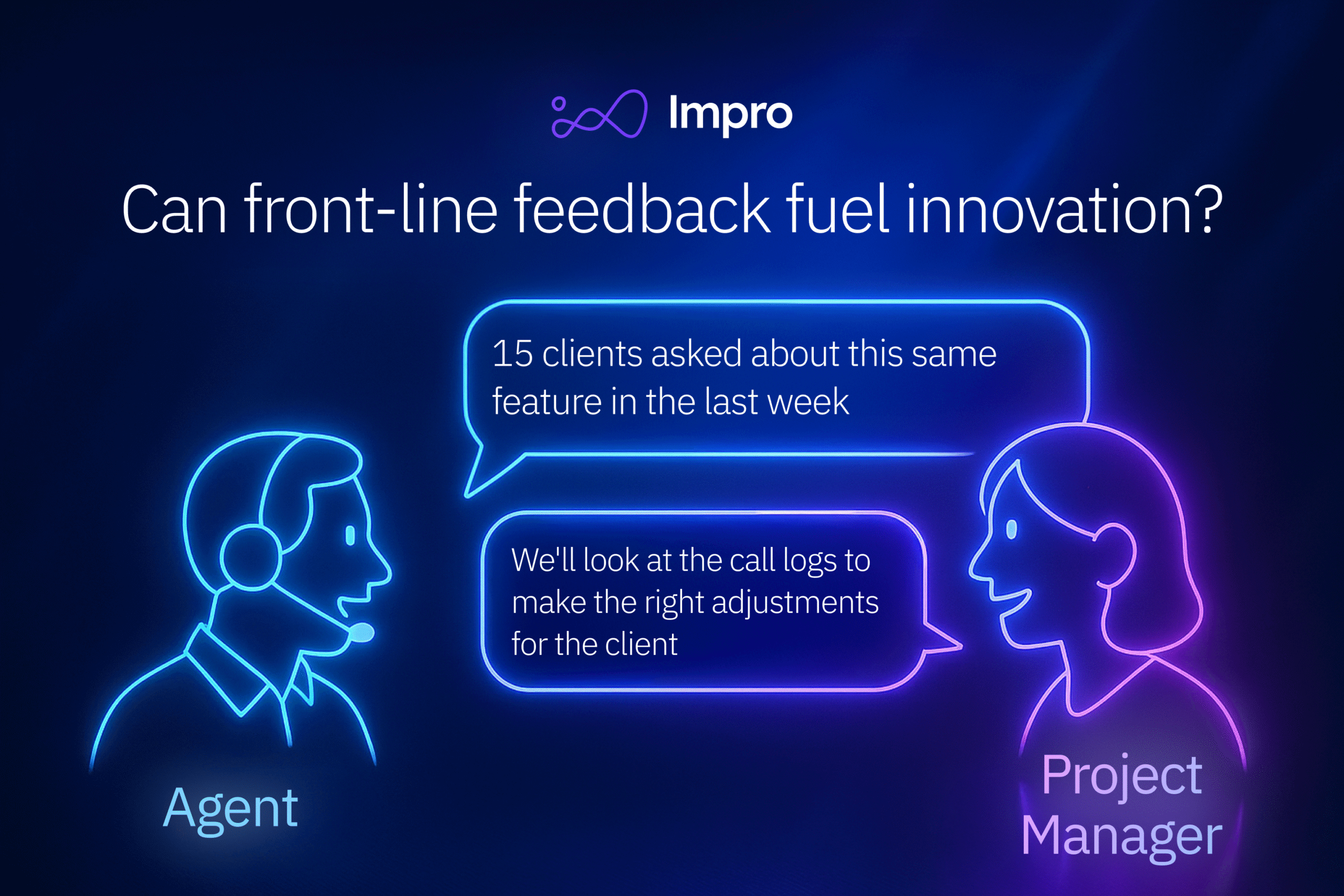
A recurring pattern has emerged across many industries: companies are sitting on a goldmine of insights hidden in plain sight within their customer service and support departments.
Every day, support teams speak with thousands of customers through calls, emails, and chats. These conversations are more than just issue resolutions; they’re full of valuable signals—what’s broken, unclear, and what customers wish existed. This feedback becomes a powerful foundation for service innovation when captured and analyzed properly.
Imagine this: a customer reaches out for the third time because they’re confused about the same billing issue. The agent solves it again, logs the ticket, and moves on. Multiply that by hundreds of similar tickets across different teams—and you’re not just solving problems, you’re sitting on a trend. One that, if spotted early, could influence pricing models, UX improvements, or even uncover gaps your competitors haven’t noticed yet.
At Impro, we work daily with dozens of executives and hundreds of customer support agents. We’ve found that in most organizations, valuable data is often overlooked, resolved, and archived—rather than mined and mobilized. As a result, opportunities for improvement, differentiation, and even new business models are being missed.
This resource is the foundation of the Customer Service for Innovation Model, a framework designed to help companies transform support conversations into a competitive edge and a source of innovative solutions.
The Premise: Innovation Begins with the Problem
There’s a common misconception that innovation mainly comes from novel ideas, which turn into unique technologies, applications, and business models. The most effective innovation doesn’t start with ideas, it starts with problems—more specifically, with the right problems.
Those problems are already being heard daily; however, instead of viewing this data as user research, most companies focus on these interactions primarily through the lens of customer experience and operational success, losing on a significant portion of the value.
Beneath those conversations lies a second layer of value: rich, actionable insight that can inform product, service, and strategy. Organizations that learn to harness this resource are opening new pathways to elevating overall business performance.
Modern Knowledge
Historically, knowledge grew slowly. Before 1900, global knowledge doubled roughly every 100 years. By the end of World War II, that cycle had shortened to 25 years. In today’s post-COVID, hyper-connected world, estimates suggest knowledge now doubles in less than 12 months — and in some domains, in under a month.
This acceleration brings challenges such as data quality concerns and increasingly complex knowledge cycles, making companies need to streamline their data collection and leverage internal sources of information to avoid analysis paralysis.
The companies making the most of today’s landscape are the ones that move with speed and intention: building, testing, learning, and refining in tight cycles. What sets them apart isn’t just pace, but clarity. Traditional organizations are investing billions in innovation, but have the opportunity to do the same by tapping into internal data they already own to guide faster, smarter decisions.
The Crossroads of Successful Product Management and Innovation: The Customer
At scale, customer service feedback offers a living snapshot of a company’s market reality. It reveals:
- Unmet or evolving needs
- Recurring friction points across products and services
- Behavioral shifts and early signs of churn
- Indicators of feature demand or usability issues
- Patterns that suggest new market segments or business models
Tens of thousands of data points are generated daily in a single enterprise support center. When structured and analyzed, these signals can directly influence product roadmaps, shape CX strategies, and accelerate responsiveness to market trends.
Making It Actionable: Closing the Loop Between Service and Strategy
For the Customer Service for Innovation Model to succeed, it must be operationalized—not just theorized. This means moving beyond passive data collection toward a system of active insight translation. Organizations that do this well share a few characteristics:
- Integrated Feedback Loops: They create formal mechanisms for routing customer service insights into product, strategy, and innovation teams on a regular cadence. Establish a recurring review where customer service leaders present aggregated insights directly to product and strategy teams.
- Cross-Functional Collaboration: Build a collaboration model where product managers, CX leaders, data scientists, and frontline agents work together to prioritize customer problems based on frequency, severity, and strategic fit.
- Insight Infrastructure: Continuing to invest in the right tools—not just CRMs and ticketing systems, but natural language processing (NLP) and thematic analysis software—to surface trends that would otherwise go unnoticed.
- Cultural Shift: Perhaps most importantly, they treat frontline voices as strategic—not operational—assets.
In one organization, a recurring theme began surfacing during coaching sessions: multiple agents, across different teams, described a particular type of customer interaction that felt unusually difficult to handle. While it wasn’t flagged in formal reports, the pattern kept coming up in conversation. When brought to the attention of leadership, it reframed the issue—not as isolated friction, but as a blind spot in the customer journey. A small shift in product design followed, leading to clearer communication, faster resolution times, and noticeably improved agent confidence.
This is what happens when frontline insights are treated as strategic inputs—not just support anecdotes.
Every customer question is a signal. Every frustration is a data point. And every recurring issue is a potential business opportunity waiting to be uncovered.
With the right mindset and systems in place, companies can renovate their approach to innovation—not by looking further outward, but by listening more deeply inward. Because sometimes, the fastest way to invent the future is to first understand what your customers are telling you in the present.

I’m passionate about implementing practical AI strategies that drive organizational value—limiting wasted resources, improving team performance, educating stakeholders, and confidently navigating the rapidly evolving AI landscape to transform vision into measurable results.
Impro Performance Strategist